
Occupied property viewing: automate management without friction
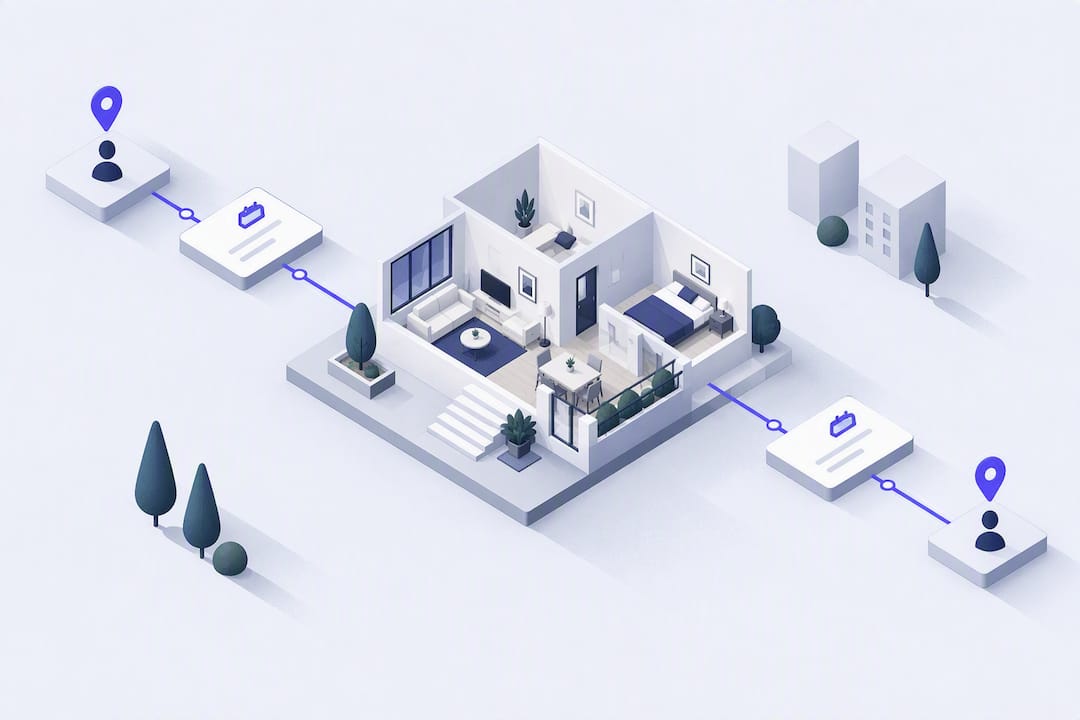
The best way to manage an occupied property viewing is to automate appointment booking, reminders, and follow-ups via a centralized SaaS software rather than through manual phone calls. This approach reduces back-and-forth communication with the tenant and visitor, limits last-minute cancellations, and documents each step. VisitSync perfectly illustrates this logic: online booking without account creation, calendar synchronization, and automatic reminders grouped in a single dashboard.
In brief:
- Automating appointment booking, reminders, and follow-ups via SaaS software helps reduce manual exchanges, prevent no-shows, and improve visit conversion.
- Effective platforms offer online booking without an account, bidirectional synchronization with Google or Outlook, and automatic SMS or email reminders.
- It is advisable to organize visits with a 10 to 15-minute buffer between each appointment to manage occupied properties smoothly.
- Property preparation should include minimal tidying, clear instructions for the occupant, and strict respect for privacy to maintain trust.
- Mastering legal rules and rigorous management of access refusals or conflicts avoids disputes and ensures calm visit organization.
Table of Contents
- Why automate occupied property visit management
- Which features to choose for managing an occupied property visit?
- How to organize a tour of visits in an occupied property?
- Scripts and checklists to standardize each visit
- Which indicators to track to improve visit efficiency?
- How to prepare an occupied property before a visit?
- What are everyone's rights and duties during a visit?
- What behavior to adopt to respect the tenant's privacy?
- What legal terms govern visits to an occupied property?
- How to defuse a conflict during a visit?
- What health precautions to take during a visit?
- What automation really changes on the ground
- VisitSync, the solution to centralize your occupied property visits
- Frequently Asked Questions
Why automate occupied property visit management
Coordinating an occupied apartment viewing requires juggling the tenant's, visitor's, and owner's schedules. Without a dedicated tool, each appointment turns into a series of calls and texts that eat into the agent's day. Real estate booking tools centralize calendars and property views, which mechanically reduces the administrative time spent on logistics.
Automation works on three concrete levels:
- Fewer manual exchanges: appointments are booked directly online, without telephone negotiation.
- Fewer no-shows: automatic confirmations and reminders reduce the number of forgotten appointments.
- Better conversion: a visitor who receives clear confirmation and access instructions arrives prepared, which facilitates making an offer.
Pro tip: automating post-visit follow-ups frees up time that the negotiator can reinvest in qualifying leads rather than in repeated phone follow-ups, according to observed feedback in agency workflows.
Which features to choose for managing an occupied property visit?
Not all scheduling platforms are created equal. Some features are essential, while others are for comfort. The most complete real estate booking platforms generally combine a dedicated page per property, bidirectional calendar synchronization, and an automated reminder system.
What really matters for organizing an occupied property visit:
- Online booking without an account: the potential tenant chooses a time slot from a property-specific page, without prior registration.
- Synchronization with Google and Outlook: availabilities are updated bidirectionally, without double entry.
- Automatic SMS or email reminders: these reduce forgotten appointments for both visitors and occupants.
- Automated cancellation management: the freed-up time slot should reopen without manual intervention.
- Time blocks and buffers: a delay between two visits prevents awkward crossings in an occupied property.
- Access instructions and post-visit notes: recorded in the same place as the appointment, so nothing gets lost along the way.
Pro tip: always set a 10 to 15-minute buffer between two visits to the same occupied property. This allows the occupant time to close up and prevents a visitor from encountering the previous one at the entrance.
How to organize a tour of visits in an occupied property?
A structured workflow transforms a chaotic day of visits into a repeatable routine. Here is the sequence that works best for occupied property visits, from first contact to final report.
- Prepare the property sheet: estimated visit duration, updated photos, internal notes accessible to the entire team.
- Open booking slots: define clear rules (hours accepted by the occupant, buffers between visits, minimum booking window).
- Automate confirmations and reminders: as soon as it's booked, the visitor receives a confirmation, then a reminder with access instructions.
- Optimize the day's itinerary: grouping visits by geographic area allows for conducting 4 to 6 visits per half-day depending on the property size and distances to travel.
- Take structured notes during the visit: visitor reactions, questions asked, blocking points.
- Send an automated report: to both the owner and the agent, with key remarks.
- Plan follow-up: a follow-up message 24 to 48 hours after the visit increases the chances of turning interest into an offer.
This breakdown avoids the classic pitfall: a busy day but no structured follow-up. The automation of post-visit reports is precisely the link most agents neglect due to lack of time.
Scripts and checklists to standardize each visit
The quality of an occupied property visit often depends on repetitive details that are best scripted once and for all.
A standard confirmation message to the tenant could be one sentence: "A visit is confirmed for [date] at [time], estimated duration 20 minutes, one visitor accompanied by the agent." Short, factual, it avoids misunderstandings about the time or duration.
Before each visit, a mental checklist is enough:
- Up-to-date property file (diagnostics, recent photos, exact area).
- Confirmation sent to the tenant at least 24 hours before.
- Route and next time slot checked to avoid any cascading delays.
- Courtesy instructions reminded to the visitor: no photos of personal belongings, no opening of cupboards without permission.
Pro tip: in case of last-minute access refusal, never negotiate on site. Reschedule the visit via the planning tool and note the reason in the property file: this protects the agent in case of a subsequent dispute.
A late cancellation should trigger an automatic procedure rather than case-by-case management: freeing up the slot, notifying the next visitor if the tour allows, and a written record of the incident.
Which indicators to track to improve visit efficiency?
Scheduling software is only valuable if the data it produces is utilized. Three indicators deserve regular monitoring: the no-show rate, the visit-to-offer conversion rate, and the number of visits conducted per agent in a given week.
The integrations that matter most for an agent:
- CRM: so that each visit automatically updates the prospect's file.
- Google and Outlook: to avoid any calendar conflicts between visits and internal appointments.
- SMS and email: the most-read reminder channels by visitors.
- Analytical dashboard: to identify which time slots generate the most cancellations.
SaaS publishers for agents generally integrate these synchronization and analysis components to enable measuring visit cadence rather than guessing it. The logic of continuous improvement remains simple: test a new reminder slot, a new message phrasing, or a new schedule, then compare the attendance rate over four weeks before generalizing the change.
How to prepare an occupied property before a visit?
An occupied property is prepared differently from a vacant one. The agent does not control the space; they must work with the occupant's daily life while presenting the property in its best light.
This preparation is structured along three axes. First, minimal tidying: ask the occupant to clear visible surfaces (countertops, tables, entrances) without demanding a complete cleaning, which would be both intrusive and rarely effective. Second, securing sensitive personal effects—documents, jewelry, medications—must remain the occupant's responsibility, but the agent should politely remind them of this in the confirmation message sent before the visit.
Finally, movement within the property must be thought out in advance: a cluttered hallway or a closed room without explanation hinders the visit and leaves a negative impression on the visitor. An automatic reminder sent the day before, including a short list of practical recommendations (airing rooms, turning on lights, putting away valuables), saves the agent from having to improvise these instructions at each appointment.
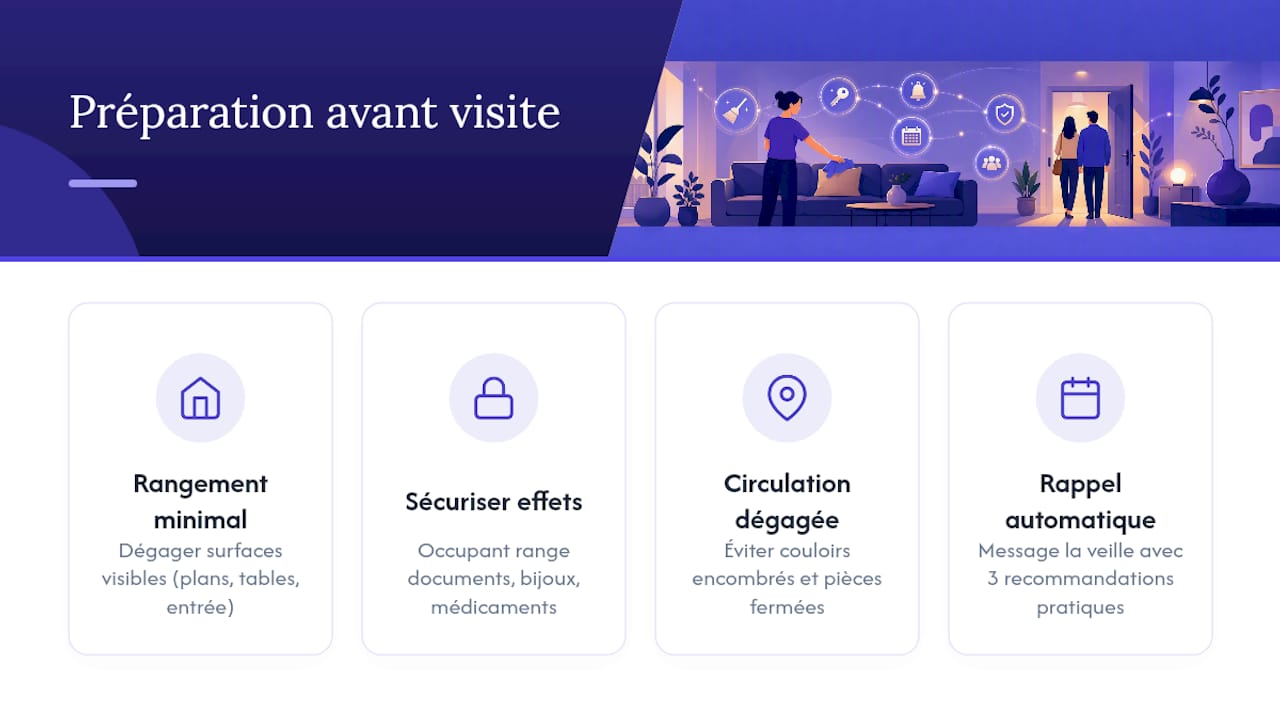
This preparation remains a balancing act: it must enhance the property without turning the visit into a disproportionate constraint for the person living there. A well-prepared occupied property, even superficially, is almost always visited better than one where the occupant discovers the visit at the last minute.
What are everyone's rights and duties during a visit?
An occupied property viewing relies on a balance between the owner's right to show their property and the occupant's right to the tranquility of their home. This balance translates concretely into rules regarding times, duration, and consent.
The occupant must be informed sufficiently in advance, with a time slot that considers their constraints rather than being unilaterally imposed. Reasonable hours are generally during the day, on weekdays, and not early morning or late evening. The duration of a visit remains short, often 15 to 30 minutes, which limits the inconvenience caused. The occupant's consent to the principle of the visit itself and to the chosen time slot forms the basis of any serene organization.
For the owner and agent, the main obligation is to respect the agreed-upon framework: not to multiply visits beyond what was announced, not to extend the duration without agreement, and to notify in case of a schedule change. A scheduling tool that clearly displays the reserved slot and sends written confirmation significantly reduces areas of ambiguity between the two parties. These rules vary according to the contractual context and country of residence; in case of doubt on a specific case, it is better to consult the lease agreement or a real estate law professional rather than relying on general practice.
What behavior to adopt to respect the tenant's privacy?
Visiting an occupied property means entering someone's home, not a showroom. This reminder, obvious on paper, is easily lost in the heat of a busy day of appointments.
Concretely, this implies a few simple but non-negotiable reflexes. The agent accompanies the visitor into each room rather than letting them circulate alone. No photos are taken of personal belongings, documents, or items lying around, even by accident. Closets, drawers, and private storage spaces are not opened without the explicit agreement of the occupant, and the agent reminds the visitor of this rule before entering.

The tone of the visit also matters: avoid comments on the occupant's lifestyle, decor, or state of maintenance, which can be perceived as intrusive even if they only aim to describe the property. A visitor who asks questions about the current occupant's habits (why they are moving, how long they have lived there) should be redirected to the agent, never directly to the occupant.
Finally, the visit must respect the announced format. If a 20-minute appointment turns into 45 minutes because the visitor asks many questions, the agent must know how to politely conclude rather than impose this extension on the occupant. This respect for the framework, repeated visit after visit, builds the trust that makes subsequent authorizations easier to obtain.
What legal terms govern visits to an occupied property?
The specific rules governing an occupied property visit depend on the current lease agreement, the status of the property (rental, sale, co-ownership), and the country or province where the property is located. There is no universal rule applicable everywhere in the same way, which makes caution advisable before any generalization.
However, what appears almost systematically in contractual frameworks are: a reasonable notice period before the visit, a restriction on visiting hours (often limited to working days and daytime slots), and the obligation to obtain the occupant's agreement on the principle of the visit itself. Some leases also specify a maximum number of visits per week or month, especially during a notice period for departure.
Given this variability, the best practice for an agent is to check the specific clauses of the relevant lease before organizing anything, and to consult a legal professional or the competent real estate regulatory body in their jurisdiction if in doubt about a particular case. Documenting every exchange with the occupant – the date of the request, the agreement given, the confirmed time slot – protects the agent and the owner in the event of a subsequent dispute. A scheduling software that maintains a timestamped history of these exchanges provides useful evidence here, well beyond simple organizational convenience.
How to defuse a conflict during a visit?
Disagreements during an occupied property visit most often arise around three points: a contested time slot, perceived intrusive behavior, or a last-minute access refusal.
When faced with an occupant contesting an already confirmed time, the best response is to refer back to the written confirmation message rather than arguing verbally. This is precisely the benefit of a system that tracks every exchange: proof of the accepted time slot already exists, which avoids a disagreement of memory against memory. If the conflict persists, immediately proposing a new time slot rather than insisting on the first one generally defuses the tension.
When a visitor exhibits behavior that the occupant deems intrusive, such as taking unauthorized photos, the agent must intervene immediately, not retrospectively. Quick and calm intervention protects the trust relationship with the occupant, an essential condition for obtaining access for subsequent visits.
An outright refusal of access remains the most delicate situation. It is never resolved by pressure or insistence on site. The best practice is to accept the postponement, note the reason given in the property file, and return to the owner to discuss an adjustment to the process if refusals are repeated. A clear history of proposed, confirmed, and canceled time slots helps to objectify the situation if it needs to be arbitrated between owner and tenant.
What health precautions to take during a visit?
Health measures during an occupied property visit remain relevant even outside periods of acute health crisis, as they reassure both the occupant and the visitor.
A few simple reflexes are usually sufficient: ventilating the property before and after each visit, limiting the number of people present simultaneously, and providing hand sanitizer at the entrance if the local health context recommends it. During periods of active circulation of a seasonal virus or a specific health alert, the agent benefits from spacing out visits further and favoring longer buffers between each appointment to limit crossovers in common areas.
Wearing a mask, when recommended by local health authorities, should remain at the discretion of the occupant who can legitimately request it for their own home. The agent communicates this instruction to the visitor before the visit rather than discovering it on-site, which avoids any unnecessary discomfort.
These precautions are best communicated automatically, via the reminder message sent before each appointment, rather than being orally reminded on a case-by-case basis. This ensures consistent application, regardless of the agent conducting the visit, and avoids oversights during busy periods.
What automation really changes on the ground
VisitSync was designed around a simple observation: most of the time lost on occupied property viewings doesn't come from the viewing itself, but from the coordination that precedes it. VisitSync's features page details how online booking, automated reminders, and calendar synchronization reduce this coordination time to a few clicks.
For an independent agent managing a dozen properties, the main challenge remains avoiding double bookings and missed reminders. For a larger team, analytical data takes over: identifying which slots generate the most cancellations, which properties convert best into offers, and adjusting the visit strategy accordingly.
What I remember most is that the tool never replaces the agent's judgment on the ground, when facing a difficult occupant or visitor. It simply eliminates the administrative friction that prevents that agent from dedicating their energy where it truly matters.
— Isac
VisitSync, the solution to centralize your occupied property visits
Between missed calls, poorly noted time slots, and forgotten reminders, manual coordination of an occupied property viewing costs dearly in time and lost opportunities. VisitSync automates the entire chain: online booking without account creation for the visitor, direct synchronization with Google and Outlook, reminders and confirmations sent without manual intervention.
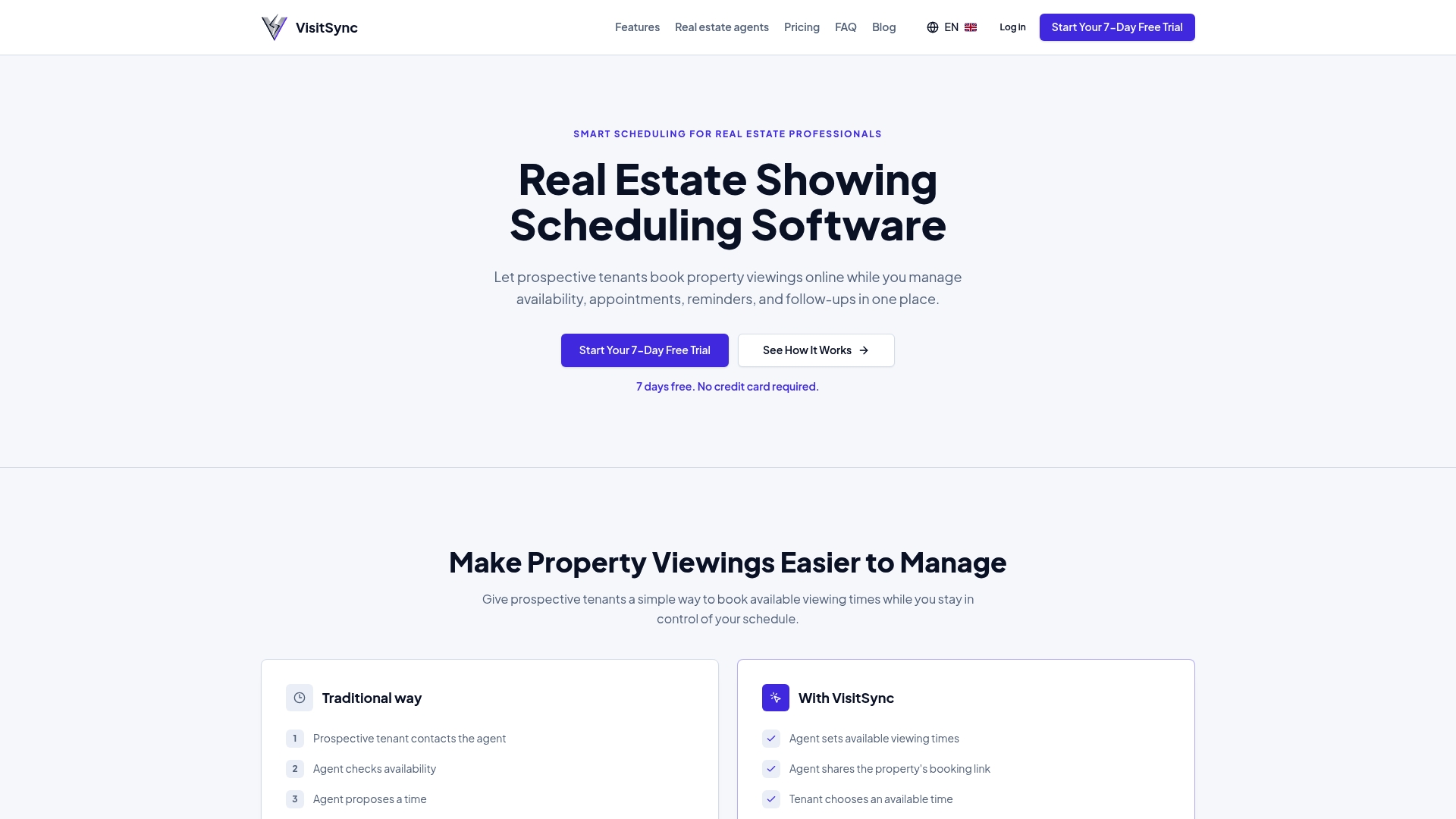
Concretely, an agent who configures their availability page on VisitSync can start receiving online bookings in ten to fifteen minutes, without prior technical training. The platform offers two monthly plans, with a free trial period to test the functionality on their own property portfolio. Agents who manage several occupied properties simultaneously will find concrete use cases adapted to their visit volume on the page dedicated to real estate agents.
The next appointment you would normally have coordinated with three calls and two texts could book itself, while you take care of something else.
Frequently Asked Questions
How does a potential tenant book a visit online?
The potential tenant accesses a page dedicated to the property and chooses an available time slot, without creating an account. With VisitSync, this booking automatically triggers a confirmation and a reminder before the appointment.
What are the conditions for visiting an occupied property?
The occupant must agree to the principle of the visit and the proposed time slot, with reasonable advance notice. The precise rules depend on the lease and the jurisdiction concerned, hence the importance of checking the contract before any occupied property visit request.
How much does visit management software like VisitSync cost?
VisitSync offers two monthly plans: Essential at $19 CAD per month and Pro at $39 CAD per month, available on Visitsync. A free trial period allows you to test the platform before committing.
How to reduce no-shows during a property viewing?
Automatic SMS or email reminders, sent the day before and on the day itself, significantly reduce missed appointments. Combined with immediate confirmation after booking, they also limit last-minute cancellations from both visitors and occupants.
What to do if the tenant refuses access at the last minute?
You must accept the postponement without negotiating on site and note the reason in the property file to keep a record of the incident. A scheduling system that logs proposed and confirmed time slots helps to objectify the situation if refusals are repeated.